
Department of Preschool Education and Social Pedagogy |  Main / Faculties / Faculty of Pedagogy and Psychology / Departments / Department of Preschool Education and Social Pedagogy / News Main / Faculties / Faculty of Pedagogy and Psychology / Departments / Department of Preschool Education and Social Pedagogy / News
27.01.2026
Analysis of the Role of Children’s Literature in the Educational Process of Preschool Institutions
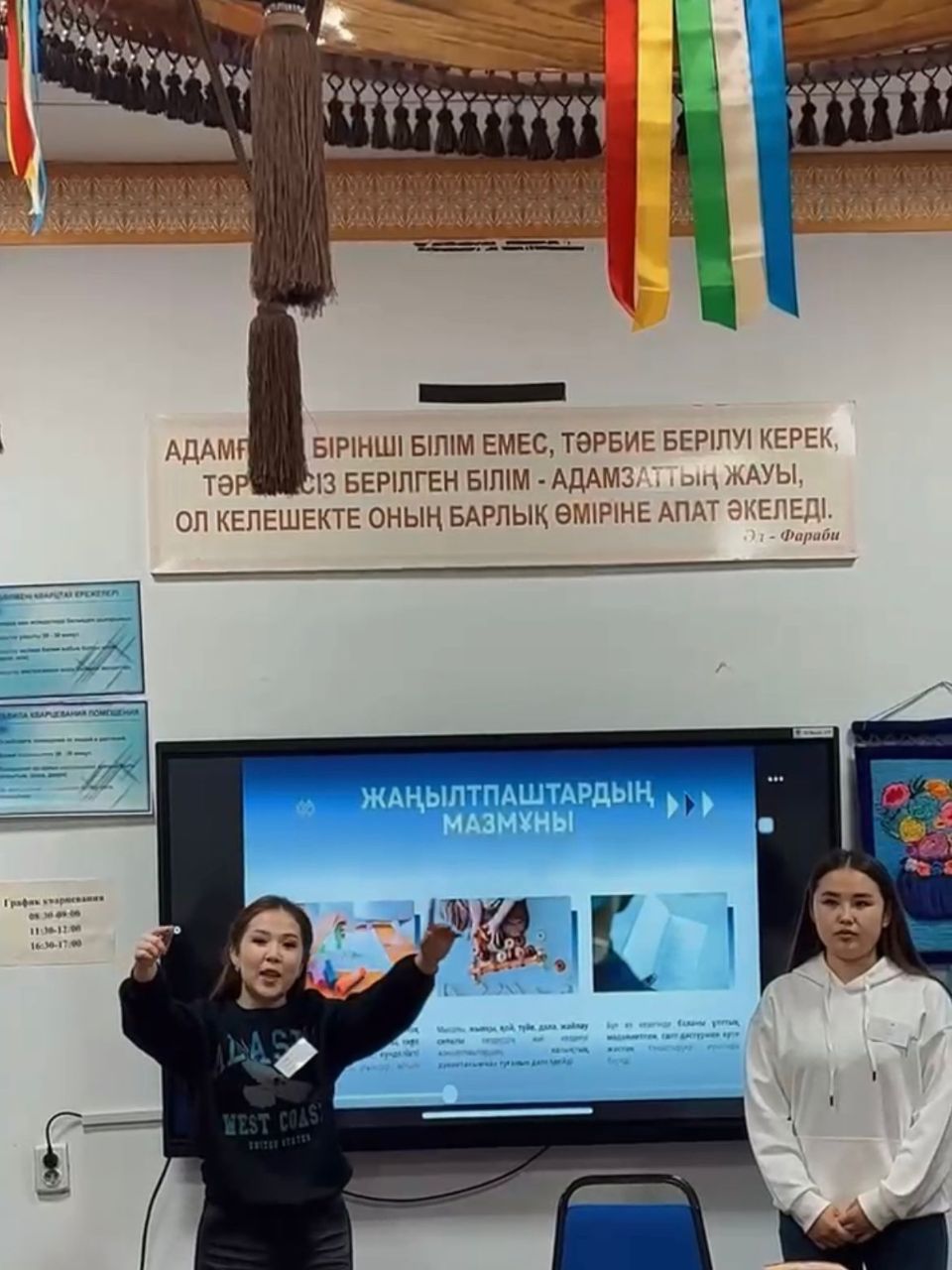
January 27, 2026, within the framework of pedagogical practice at the Faculty of Pedagogy and Psychology of Abai Kazakh National Pedagogical University, the Department of Preschool Education and Social Pedagogy organized a practical class within the course “Children’s Literature” on the topic “Folk Oral Literature as the Foundation of Children’s Literature.” The practical class was conducted by a 2nd-year doctoral student of the educational program 8D01201 – Preschool Education and Upbringing, Dzhanegizova Ulsaya Sabyrkhanovna (scientific supervisor –PhD, Professor A.E.Mankesh), for 3rd-year students of the educational program 6B01201 – Preschool Education and Upbringing (course instructor – Candidate of Pedagogical Sciences, Associate Professor G.Z. Taubayeva).The main objective of the practical class was to provide students with a deeper understanding of the historical, educational, and artistic significance of folk oral literature in the formation of children’s literature, as well as to develop practical skills in using folklore genres such as fairy tales, proverbs and sayings, tongue twisters, counting rhymes, riddles, and lullabies in the development of preschool children’s speech, thinking, and moral and spiritual values.During the class, the genre characteristics of folk oral literature were analyzed, and their relevance to the psychological and age-related characteristics of preschool children was examined through concrete examples. Group and pair work activities were organized, allowing students to practically explore the educational and developmental potential of each folklore genre.Interactive teaching methods were actively applied throughout the session, including question-and-answer activities, discussions, and situational tasks, which contributed to increasing students’ cognitive engagement and professional reflection. The students proposed their own approaches to integrating folk oral literature into the educational process of preschool institutions and presented their ideas in a well-reasoned manner.As a result of the practical class, students recognized folk oral literature as the foundation of children’s literature from both theoretical and practical perspectives and developed the knowledge and skills necessary to effectively apply national values in their future professional practice. The session concluded with a feedback activity during which students shared their reflections and suggestions. The conducted class contributed to the development of students’ professional competencies and to the enhancement of the doctoral student’s pedagogical skills within the framework of pedagogical practice. ]
Вернутся назад |











|
050010, Republic of Kazakhstan Almaty, Dostyk аve., 13
e-mail: rector@abaiuniversity.edu.kz

|
|
Office: 8 (727) 390 60 05
Admissions Office/Call center: 8 (727) 390 60 04 8 (700) 390 60 04
8 (727) 291 57 68
Сitizen reception on personal matters
|
 Version for visually impaired persons